
Dermal Biostimulatory Fillers · Bonita Springs, Fl
RHA® Collection Fillers in Bonita Springs, FL
The First & Only FDA-Approved Hyaluronic Acid Fillers Designed for Dynamic Facial Movement
The RHA® Collection by Teoxane is a next-generation line of resilient hyaluronic acid fillers — the first and only FDA-approved HA fillers specifically designed to move with your facial expressions rather than resist them. Powered by Preserved Network Technology (PNT), RHA® fillers more closely mimic the natural hyaluronic acid found in your skin, allowing for results that look undetectable at rest and in motion. Dr. Katherine Ortiz offers the full RHA® Collection at DNA Wellness and Longevity Institute in Bonita Springs — tailored precisely to each patient's anatomy, movement patterns, and aesthetic goals.
Why patients choose us
FDA-Approved
First and only HA filler line FDA-approved for dynamic facial wrinkles
Preserved Network Technology
Gentle, heatless crosslinking that preserves natural HA structure
SW Florida
Serving Bonita Springs, Naples, Estero & Fort Myers


What Makes RHA® Different?
Resilient Hyaluronic Acid, Built for Movement
Traditional hyaluronic acid fillers are manufactured through a crosslinking process that uses chemical agents and heat — producing a gel that is structurally modified from natural HA and, as a result, does not behave like the HA your skin naturally produces. When injected into dynamic areas of the face — around the mouth, the cheeks during smiling, the nasolabial folds during expression — traditional fillers can resist movement, producing a stiff or unnatural appearance that is particularly visible in photographs and video. This is the "done" look that most patients want to avoid.
The RHA® Collection addresses this at the molecular level through Preserved Network Technology (PNT) — a gentle, heatless, homogenous crosslinking process developed by Teoxane in Geneva that preserves the natural long-chain HA structure rather than fragmenting it. The resulting gel more closely resembles the native hyaluronic acid found in the dermis — maintaining the same molecular architecture, viscoelastic properties, and capacity for dynamic deformation. When your face moves, RHA® moves with it, deforming and recovering elastically rather than resisting or displacing. The clinical result is volume and correction that is undetectable in motion.
The RHA® Collection is the first and only line of hyaluronic acid fillers FDA-approved specifically for the correction of dynamic facial wrinkles and folds — a regulatory distinction that reflects its unique mechanism and the clinical evidence supporting it. In January 2026, the collection expanded with FDA approval of RHA® Dynamic Volume for cheek augmentation and midface contour deficiencies — adding structural volumizing capability to a line already proven in dynamic wrinkle correction. As of August 2025, the RHA® Collection is formulated with mepivacaine (replacing lidocaine) — a newer, more effective anesthetic that represents the first major anesthetic innovation in HA fillers in nearly two decades, improving patient comfort during injection.
How It Helps
Five Products, One Comprehensive Facial Range
RHA® Redensity — Perioral Lines & Fine Dynamic Wrinkles
FDA Status: FDA-approved for moderate to severe dynamic perioral rhytids (lines around the mouth)
RHA® Redensity is the most delicate formulation in the collection — specifically engineered for the perioral area, where the skin is thinnest and facial movement is most constant. The perioral region (the area surrounding the mouth including the upper lip, lower lip, and the skin above the vermilion border) is one of the most technically challenging areas to treat with traditional fillers: incorrect product selection produces visible bumps, unnatural stiffness, or an overfilled appearance that reads as obviously treated.
RHA® Redensity is formulated with the lowest crosslinking density in the collection, giving it the highest flexibility and lowest viscosity — designed specifically to flow into fine perioral lines and integrate with the surrounding tissue without creating fullness or bulk. It softens the fine dynamic lines that appear with smiling, speaking, and everyday expression, while simultaneously restoring subtle hydration and skin quality in this delicate zone. It is not designed to volumize the lips significantly — it addresses the fine rhytid lines around the mouth that other fillers cannot treat without overcorrecting.
Best for: Perioral fine lines and rhytids, the fine lines around the mouth that appear with movement, patients seeking subtle refinement rather than volumization in this area.
RHA® 2 — Moderate Dynamic Wrinkles & Early Facial Lines
FDA Status: FDA-approved for moderate to severe dynamic facial wrinkles and folds including nasolabial folds in adults 22+
RHA® 2 is the lightest volumizing formulation in the collection — designed for moderate dynamic expression lines in areas of frequent movement where a soft, flexible result is essential. The nasolabial folds (the lines running from the nose to the corners of the mouth), early marionette lines, and perioral dynamic wrinkles respond well to RHA® 2's balance of correction and flexibility.
Unlike RHA® Redensity, which addresses only fine surface lines, RHA® 2 provides light-to-moderate volume correction that smooths the fold or line while preserving natural facial dynamics. It is the appropriate choice for patients who are beginning to notice deepening of their nasolabial folds during expression and at rest, or for patients who want to soften early perioral lines with slightly more correction than Redensity provides. It is also frequently used for subtle cheek enhancement and under-eye area softening in patients with mild volume deficit in these areas.
Best for: Moderate nasolabial folds, early marionette lines, perioral dynamic wrinkles, light cheek enhancement, patients new to filler wanting a natural, conservative result.
RHA® 3 — Deeper Dynamic Folds & Nasolabial Correction
FDA Status: FDA-approved for moderate to severe dynamic facial wrinkles and folds in adults 22+
RHA® 3 is the mid-range volumizing formulation — offering greater lifting and corrective power than RHA® 2 while maintaining the dynamic elasticity that defines the RHA® collection. It is designed for more pronounced nasolabial folds, deeper marionette lines, and other moderate-to-severe dynamic folds where meaningful volume correction is needed without sacrificing natural expression.
Its rheological properties — higher cohesivity and lift capacity than RHA® 2, combined with RHA®'s characteristic dynamic deformability — make it particularly well-suited for patients who have tried standard HA fillers in these areas and found them either too stiff, too heavy, or unable to maintain a natural look during facial movement. RHA® 3 is also used for lip volumization in Europe and increasingly off-label in the US for patients seeking more pronounced lip volume with a natural, dynamic feel rather than a static, overfilled appearance. Its cohesive properties allow it to integrate well into lip tissue and move naturally with speaking and smiling.
Best for: Moderate-to-severe nasolabial folds and marionette lines, patients with more advanced facial fold depth, lip volumization (discuss with Dr. Ortiz), patients who found previous fillers too stiff in dynamic areas.
RHA® Dynamic Volume — Midface Volumizing & Cheek Augmentation
FDA Status: FDA-approved (January 2026) for cheek augmentation and correction of age-related midface contour deficiencies in adults 22+
[NEW — launched Q1 2026]
RHA® Dynamic Volume is the newest and most structurally robust member of the RHA® Collection, receiving FDA approval in January 2026 for midface volumizing — expanding the collection into structural contouring territory previously occupied by fillers like Juvéderm Voluma XC. Formerly known as RHA® 4 Mepi, it was relaunched under its new name to reflect its specific clinical positioning: dynamic volume restoration that maintains its structural integrity while allowing natural facial movement.
Powered by PNT at its highest crosslinking density in the collection, RHA® Dynamic Volume delivers the lifting force and structural support needed to restore descended midface volume and define cheekbone architecture — while retaining the dynamic deformability that distinguishes all RHA® products. In a 52-week randomized, double-blind head-to-head clinical trial versus Juvéderm Voluma XC, RHA® Dynamic Volume achieved comparable aesthetic outcomes with fewer treatments and touch-ups, and patient-reported natural look at rest and in motion exceeded 94% through one full year. This makes it a compelling option for patients who have experienced stiffness or an unnatural appearance with volume fillers in the cheeks and midface.
Best for: Cheek augmentation, midface volume restoration, jawline structural support, patients who want volumizing results with natural dynamic movement rather than a static or heavy appearance.FDA Status: FDA-approved for moderate to severe dynamic facial wrinkles and folds including nasolabial folds in adults 22+
RHA® 2 is the lightest volumizing formulation in the collection — designed for moderate dynamic expression lines in areas of frequent movement where a soft, flexible result is essential. The nasolabial folds (the lines running from the nose to the corners of the mouth), early marionette lines, and perioral dynamic wrinkles respond well to RHA® 2's balance of correction and flexibility.
Unlike RHA® Redensity, which addresses only fine surface lines, RHA® 2 provides light-to-moderate volume correction that smooths the fold or line while preserving natural facial dynamics. It is the appropriate choice for patients who are beginning to notice deepening of their nasolabial folds during expression and at rest, or for patients who want to soften early perioral lines with slightly more correction than Redensity provides. It is also frequently used for subtle cheek enhancement and under-eye area softening in patients with mild volume deficit in these areas.
Best for: Moderate nasolabial folds, early marionette lines, perioral dynamic wrinkles, light cheek enhancement, patients new to filler wanting a natural, conservative result.

Your Journey
What To Expect with Dr Ortiz
Step 01 — Consultation & Product Selection Your RHA® consultation with Dr. Ortiz begins with a facial anatomy assessment — evaluating the location, depth, and character of the lines or volume concerns you want to address, your natural facial movement patterns, your prior filler history if any, and your aesthetic goals. Product selection is clinical, not promotional: Dr. Ortiz determines which formulation in the RHA® Collection — or combination of formulations — is appropriate for your specific anatomy and concern. Patients with a history of filler complications, allergy to HA or mepivacaine, active skin infection in the treatment area, or bleeding disorders are evaluated carefully before proceeding.
Step 02 — The Treatment Session RHA® fillers now contain mepivacaine — a newer local anesthetic replacing lidocaine as of August 2025 that provides effective pain management from injection onset. A topical numbing cream may also be applied to sensitive areas before treatment. Dr. Ortiz uses precise injection technique — cannula or needle depending on the area — to deliver RHA® at the appropriate tissue depth for each application. Treatment sessions typically take 30–45 minutes for single-area treatments and 45–75 minutes for multi-area protocols. Common post-treatment effects include mild swelling, bruising, and redness at injection sites — typically resolving within 3–7 days.
Step 03 — Results & Longevity RHA® results are visible immediately — the gel provides correction from the moment of injection. As post-procedure swelling resolves over 1–2 weeks, results settle to their natural endpoint. Clinical durability varies by product: RHA® Redensity and RHA® 2 typically last 12–15 months; RHA® 3 and RHA® Dynamic Volume last 15–18 months in most patients. RHA®'s clinical trials demonstrate maintained correction at 15 months without touch-up in a meaningful proportion of patients — a durability profile comparable to or exceeding many standard HA fillers in the same indications. Like all HA fillers, RHA® products can be dissolved with hyaluronidase if needed, providing a safety profile and reversibility that biostimulatory injectables (Radiesse®, Sculptra®) do not offer.
Questions Answered
Frequently Asked Questions About the RHA® Collection
Q1: What makes RHA® different from Juvederm or Restylane? Juvederm, Restylane, and most other HA fillers are FDA-approved for static wrinkles and folds — lines visible at rest. The RHA® Collection is FDA-approved specifically for dynamic wrinkles — the lines that appear and deepen with facial movement. The clinical distinction comes from the manufacturing process: Teoxane's Preserved Network Technology (PNT) uses a gentle, heatless crosslinking process that preserves the natural long-chain HA structure, producing a gel that deforms elastically during facial movement and recovers at rest — unlike standard fillers that resist movement. For patients who have experienced stiffness, visible filler during expression, or an unnatural look in motion with other filler brands, RHA®'s dynamic formulation is a meaningfully different product, not just a different label.
Q2: Is the RHA® Collection FDA-approved? Yes. The RHA® Collection by Teoxane is FDA-approved, and it holds a regulatory distinction that no other HA filler line in the US has achieved: it is the first and only HA filler line FDA-approved specifically for dynamic facial wrinkles and folds. Specific approvals include: RHA® Redensity for moderate to severe dynamic perioral rhytids (lines around the mouth); RHA® 2 and RHA® 3 for moderate to severe dynamic facial wrinkles and folds including nasolabial folds; and RHA® Dynamic Volume (approved January 2026) for cheek augmentation and correction of age-related midface contour deficiencies — all in adults aged 22 and older.
Q3: Which RHA® product is right for my concern? The RHA® Collection is designed as a graduated system — each product is formulated for a specific depth and degree of correction. RHA® Redensity is for fine perioral lines and rhytids around the mouth. RHA® 2 is for moderate dynamic lines and light volumizing including early nasolabial folds and subtle cheek enhancement. RHA® 3 addresses deeper dynamic folds like pronounced nasolabial and marionette lines. RHA® Dynamic Volume provides structural midface volumizing and cheek augmentation. The right product — or combination — depends entirely on your anatomy, the depth and location of your concern, and your goals. Dr. Ortiz determines this at consultation after evaluating your facial structure and movement patterns.
Q4: Can RHA® fillers be dissolved if I don't like the result? Yes — all RHA® products are hyaluronic acid-based and can be dissolved with hyaluronidase, an enzyme that breaks down HA. This reversibility is a meaningful safety advantage over biostimulatory injectables like Sculptra® or Radiesse®, which cannot be removed once injected and must be allowed to degrade naturally. If you experience a result you are unhappy with, Dr. Ortiz can dissolve the filler and reassess. This reversibility also makes RHA® fillers an appropriate starting point for patients who are new to facial injectables and want the option of a reset.
Q5: Are RHA® fillers available in Bonita Springs and Southwest Florida? Yes. DNA Wellness and Longevity Institute, located at 26800 S Tamiami Trail, Suite 380 in Bonita Springs, offers the full RHA® Collection by Teoxane under the direct supervision of Dr. Katherine Ortiz. The clinic serves patients throughout Bonita Springs, Naples, Estero, Fort Myers, and surrounding Southwest Florida communities. Call (239) 250-7930 to schedule your consultation.
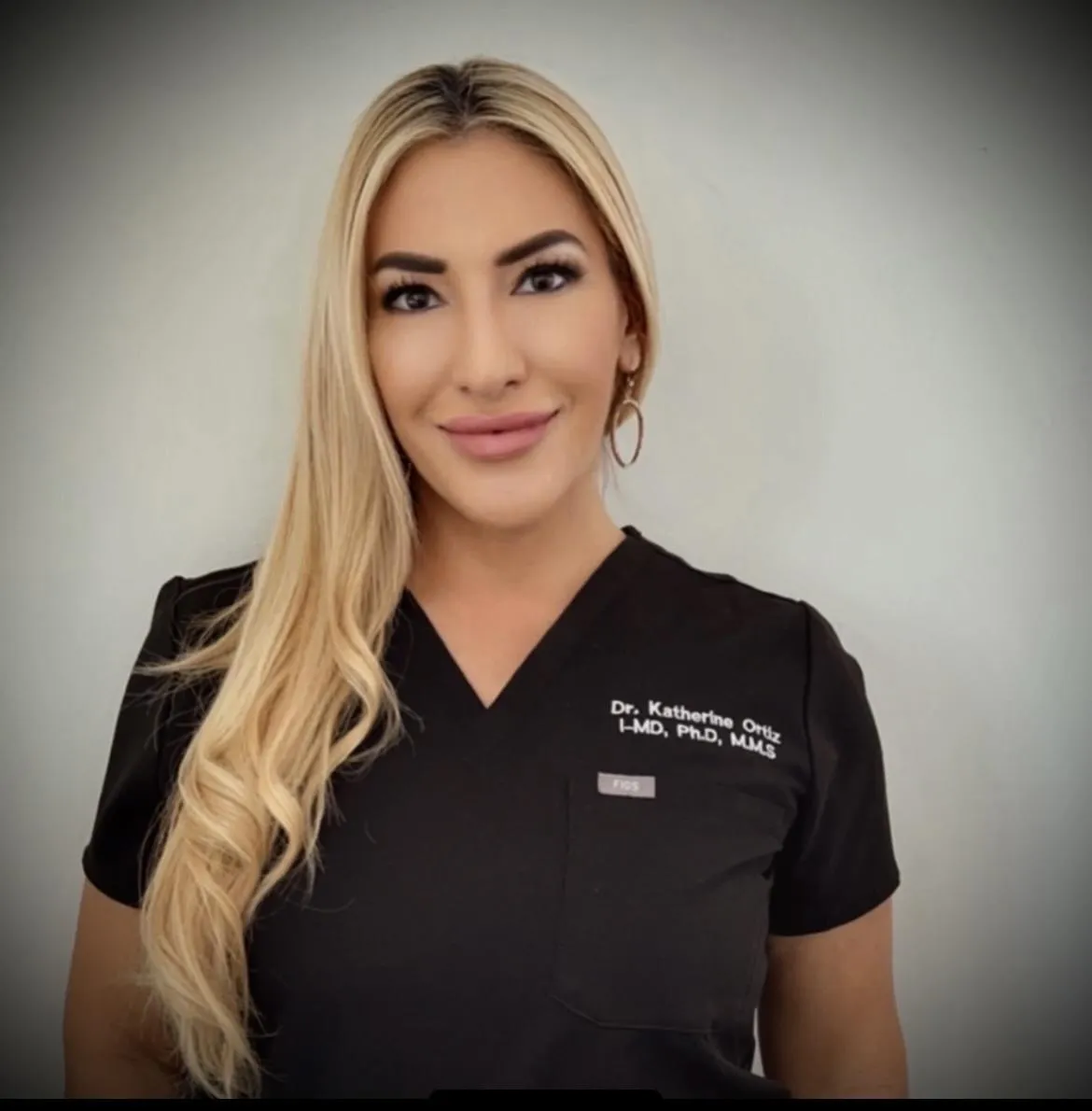
Meet Dr. Katherine Ortiz
Dr. Katherine Ortiz is the founder of DNA Wellness and Longevity Institute in Bonita Springs, FL. She is a board-certified Physician Associate and holds a Ph.D. in Integrative Medicine from Quantum University, with fellowship training through the American Academy of Anti-Aging Medicine (A4M) and the University of South Florida in functional and regenerative medicine.
Her practice is built on a foundational belief: that the body has an extraordinary capacity to heal and self-regulate when given the right support. Dr. Ortiz investigates root causes — hormonal imbalances, nutritional deficiencies, genetic factors — and builds individualized protocols designed to restore function and optimize long-term health.
Every protocol at DNA Wellness is ordered, reviewed, and monitored directly by Dr. Ortiz.


